


Tajikistan and the EU Parliament held a high-level meeting to deepen bilateral and multilateral cooperation

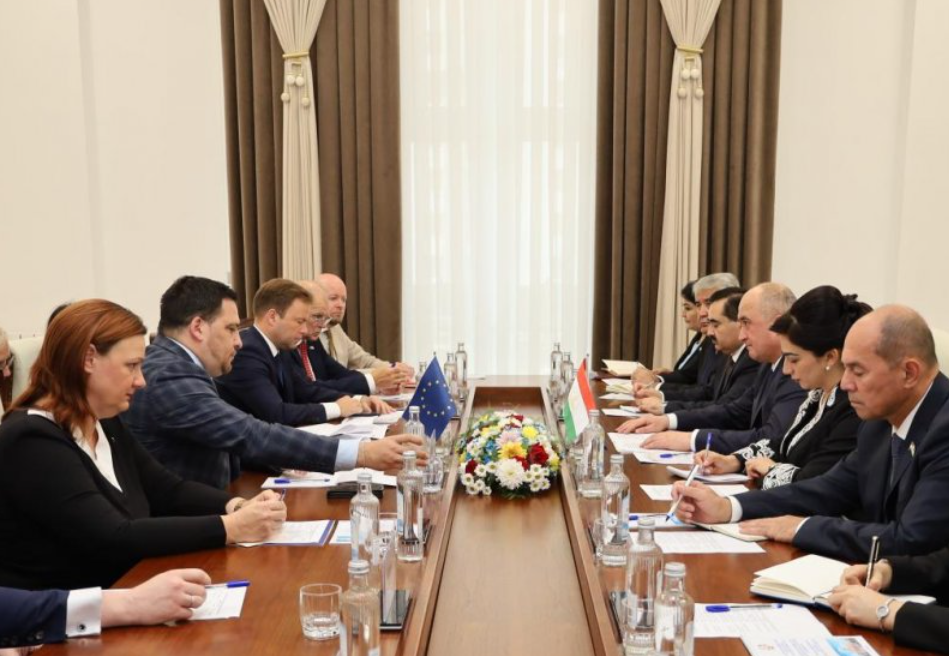
The high-level dialogue between the Speaker of the Lower House of the Tajik Parliament and the European Parliament delegation marked a new phase in bilateral cooperation in the political, economic, and environmental fields.
On September 15, 2025, Faizali Idizodá, Speaker of the Lower House of the Tajik Parliament, met in Dushanbe with a delegation of MEPs led by Giuseppina Princi, President of the European People's Party and Co-Chair of the 12th meeting of the Tajik-EU Parliamentary Cooperation Committee.
The meeting, a key component of the inter-parliamentary exchange mechanism, aimed to explore the prospects for cooperation between Tajikistan and the EU in bilateral and multilateral frameworks and emphasize the importance of strengthening inter-parliamentary ties.
01 Background and Key Topics of the Talks
The relationship between Central Asian countries and the EU is primarily governed by two strategic documents: the Partnership and Cooperation Agreement signed in 2004 and the updated EU Central Asia Strategy adopted in 2019.
Within this framework, the "Roadmap for Strengthening Connectivity between Central Asia and the EU," adopted in 2023, aims to deepen mutually beneficial cooperation between the two sides in areas such as political security, economic trade, energy, and people-to-people exchanges.
The agenda of the talks focused particularly on expanding cooperation in the areas of environment and water resources, as well as Tajikistan's accession to the EU's Generalized System of Preferences (GSP) and GSP+ programs. Tajikistan has formally expressed interest in joining GSP+.
02 Diversified Areas of Cooperation
Tajikistan's cooperation with the EU covers several key areas. Educational exchanges, promoting university cooperation through programs such as Tempus, Erasmus Mundus, and Erasmus+, are considered a key area of cooperation by both sides.
Regarding energy security, the EU seeks to diversify its energy supply sources and break away from dependence on a single region. Tajikistan possesses abundant hydropower resources, and cooperation in the clean energy sector holds significant potential.
Building legal capacity is also a key area of cooperation. The EU supports Tajikistan's judicial reforms, including reforming the judicial system and developing effective legislation, such as administrative and commercial law. The German Agency for Technical Cooperation (GTZ) and other institutions provided funding for judicial training and legal reform projects.
03 Role in the Regional Strategic Landscape
This meeting took place shortly after the first Central Asia-EU Summit. In April 2025, leaders of the five Central Asian countries and the EU held a summit in Samarkand, Uzbekistan, announcing the establishment of a strategic partnership.
During the summit, the two sides signed a declaration of intent for cooperation on critical raw materials, and European Commission President Ursula von der Leyen announced the launch of a €12 billion Global Gateway Investment Plan.
The EU's Central Asia policy is highly independent and rarely influenced by US factors. Since adopting the Central Asia Strategy in 2019, the EU has annually developed complementary measures and launched a series of initiatives to expand its partnership with Central Asian countries in areas such as energy, digitalization, and climate change.
In recent years, the EU has become increasingly grounded in its Central Asia policy, largely moving away from issues like human rights and focusing primarily on energy and transportation infrastructure.
04 Institutionalized Cooperation Mechanisms
Tajikistan and the EU have continuously advanced collaboration in key areas through Cooperation Council meetings, high-level delegation exchanges, and other parliamentary diplomacy mechanisms, particularly through the effective use of existing cooperation tools.
Regular Cooperation Council meetings, including this 12th meeting held in Tajikistan, have injected tangible momentum into the development of bilateral relations.
The EU-Tajikistan Partnership and Cooperation Agreement strengthens the EU's political, economic, and trade presence in Central Asia and provides a framework for future cooperation. The agreement is one of the first EU agreements to include provisions for cooperation in new areas such as weapons of mass destruction, migration, and terrorism.
Human rights dialogue is also a key component of bilateral relations. Since the first dialogue in Dushanbe on October 31, 2008, EU and Tajik government officials have met annually to discuss human rights issues of mutual concern.
05 Future Prospects and Challenges
Faced with global geopolitical changes and economic uncertainty, cooperation between Tajikistan and the EU faces both opportunities and challenges.
The EU has become a key trading partner and investor in Central Asian countries. As a unified economic entity, the EU is the largest trading partner and largest investor in Central Asia, accounting for 40% of its investment in Central Asia.
Tajikistan hopes to leverage the EU's technological and financial strengths to promote economic modernization and sustainable development; the EU, in turn, values Tajikistan's strategic value in regional security, energy resources, and geographical location.
Cooperation between the two sides on environmental issues such as climate change and water resource management also holds broad prospects. As a mountainous country with abundant glacier resources, Tajikistan's experience in water resource management and glacier protection is of great significance to both the EU and the Central Asian region.
New opportunities are emerging in EU-Central Asian relations. In April 2025, the first "Central Asia-EU" summit was held in Samarkand, Uzbekistan, where the EU announced the launch of a €12 billion "Global Gateway Investment Plan" to support cooperation in key raw materials, clean energy, and other areas.
European Commission President Ursula von der Leyen noted that Central Asia's critical mineral resources, such as manganese, lithium, and graphite, are "the lifeblood of the future global economy."
The parliamentary exchange mechanism between Tajikistan and the European Union is not only a stabilizer of bilateral relations, but also an important bridge to promote deeper cooperation between the two ends of the Eurasian continent.


Comments