


Kazakhstan-Japan Relations Enter a New Stage: Prospects for the "Central Asia + Japan" Dialogue and Multi-Field Cooperation

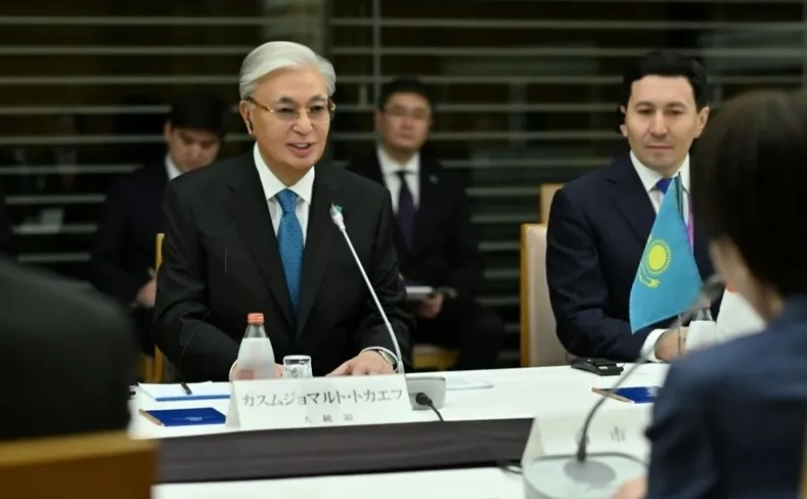
Kazakhstan's President Kassym-Jomart Tokayev and Japanese Prime Minister Sanae Takaichi shake hands and pose for a photo in Tokyo, against the backdrop of the "Central Asia + Japan" dialogue mechanism, which has been in place for over two decades.
"This visit marks a new stage in our bilateral relations," Kazakh President Tokayev announced during his meeting with Japanese Prime Minister Takaichi on December 18, 2025, in Tokyo.
Tokayev stated, "We often refer to Japan as a distant neighbor, but we regard it as a close and reliable friend." He reviewed the institutional foundation of the bilateral relationship—the "Central Asia + Japan" dialogue mechanism, which he and the Japanese Foreign Minister jointly initiated in 2004.
Prime Minister Sanae Takaichi responded, “Twenty-one years ago, you chaired the first Foreign Ministers’ Meeting under the ‘Central Asia + Japan’ framework. Today, as President, you will participate in the Heads of State Meeting under the ‘Central Asia + Japan’ framework.” She emphasized that Japan views Kazakhstan as a “strategic partner in strengthening a free and open world order based on the rule of law.”
01 The Evolution of the “Central Asia + Japan” Mechanism
The “Central Asia + Japan” dialogue mechanism has been in operation for over two decades since its first Foreign Ministers’ Meeting in August 2004. This mechanism was the first “C5+1” cooperation framework established between non-regional countries and the five Central Asian countries, and was later emulated by the United States, South Korea, India, and other countries.
The development of this mechanism has gone through four distinct stages: the institutionalization period (2004-2007), the low ebb period (2008-2012), the stable development period (2013-2019), and the adjustment and transformation period (2020-present).
In the early stages of its institutionalization, Japan and Central Asian countries established three principles: respect for diversity, competition and coordination, and open cooperation. They also set five major goals, including achieving peace, stability, and democracy in Central Asia, strengthening the economic foundation, and promoting regional cooperation.
The second Foreign Ministers' Meeting in June 2006 formulated the first action plan, propelling the mechanism towards institutionalization. Simultaneously, five major areas of cooperation were established: policy dialogue, regional cooperation, business promotion, knowledge dialogue, and people-to-people exchanges, with people-to-people exchanges designated as a pillar of cooperation.
As of June 2024, the "Central Asia + Japan" dialogue mechanism had held nine Foreign Ministers' Meetings, 16 Senior Officials' Meetings, and 12 "Tokyo Dialogues."
The development of this mechanism is closely related to the Japanese political situation and the international landscape. During Shinzo Abe's administration (2012-2020), the mechanism entered a period of stable development. The fifth Foreign Ministers' Meeting in 2014 marked the first time all member countries' foreign ministers participated, and the "Roadmap for Agricultural Cooperation" was adopted.
02 Strategic Considerations in the Geopolitical Context
Japan's diplomatic strategy towards Central Asia can be traced back to the 1990s. In July 1997, then-Prime Minister Ryutaro Hashimoto proposed the "Silk Road Regional Diplomacy" strategy, indicating a commitment to establishing peaceful and stable diplomatic relations with Central Asia and the Caucasus region.
In November 2006, Japanese Foreign Minister Taro Aso proposed the "Arc of Freedom and Prosperity" strategic framework, aiming to unite emerging democracies on the periphery of Eurasia. This strategy indicated that Japan's diplomatic strategy towards Central Asia was beginning to take shape.
Japan's Central Asia policy is driven by multiple motivations. On the one hand, Central Asia is a vital transportation corridor connecting Eurasia and is also one of the world's major energy-producing regions and transportation corridors.
On the other hand, Japan attempts to balance the traditional influence of China and Russia by enhancing its influence in the region.
Following the outbreak of the Russia-Ukraine conflict in 2022, Japan has become even more proactive in courting Central Asian countries. At the 9th Central Asia + Japan Foreign Ministers' Dialogue held in December 2022, the Japanese side raised hot issues such as the "Ukraine crisis" and took the opportunity to mention the situation in East Asia, including China and North Korea, expressing concern about the regional situation.
Japanese Foreign Minister Yoshimasa Hayashi emphasized at the joint press conference after the meeting that he "hopes to help Central Asian countries conduct balanced diplomacy," which essentially encourages Central Asian countries to weaken their traditional relations with China and Russia and guide their diplomatic balance towards the West.
03 Kazakhstan's Multi-faceted and Balanced Diplomacy
President Tokayev's visit to Japan is a continuation of his multi-faceted and balanced diplomatic policy. During the Shanghai Cooperation Organisation Summit in Tianjin in August 2025, Tokayev met with President Xi Jinping, emphasizing that "Kazakhstan-China relations are at an unprecedented high level," and that bilateral trade reached a record high last year, with major projects progressing smoothly.
In his diplomatic practice, Tokayev emphasizes balancing relations with major powers. During the 2022 presidential election, he explicitly stated that Kazakhstan must pursue a "multi-directional diplomacy" policy.
In concrete actions, Kazakhstan is deepening its comprehensive strategic partnership with China while maintaining close cooperation with Western countries such as Japan and the United States.
In July 2024, Tokayev, in an interview with Xinhua News Agency, stated, "The Kazakh-Chinese relationship is built on a solid foundation of friendship and good neighborliness. Genuine friendship and trust will help achieve new and great goals." He also highly praised President Xi Jinping's concept of building a community with a shared future for mankind, believing that this concept has urgent practical significance in the current international situation.
Meanwhile, Kazakhstan is also cooperating with Japan in areas such as nuclear safety. In early 2024, Japanese nuclear energy experts arrived in Kurchatov, East Kazakhstan Region, to hold discussions and seminars on the safety of nuclear power plant construction in Kazakhstan.
Experts from both Kazakhstan and Japan stated that safety will be the core issue for future nuclear power plants in Kazakhstan, and that every effort must be made to ensure that the risk index of the East Kazakhstan nuclear power plant, which will be operational in 10 years, is reduced to the lowest possible level.
04 Prospects for Economic and Energy Cooperation
During the talks between Tokayev and Sanae Takaichi, the two sides focused on the prospects for developing bilateral relations in the fields of trade, investment, transportation and logistics, energy, and people-to-people exchanges. These areas reflect the complementarity of the two countries' economies.
Japan, as a developed country highly dependent on resource imports, needs to import more than 90% of its energy. Kazakhstan, as the largest economy in Central Asia, possesses abundant natural resources, especially uranium production, accounting for more than 40% of global production, and has considerable reserves of strategic resources such as copper and rare earth elements.
In the energy sector, Japan possesses advanced nuclear energy technology, while Kazakhstan has abundant uranium resources and a demand for nuclear energy development. Tetsuro Iwami, President of Marubeni Corporation of Japan, pointed out during a meeting with Kazakh experts that Japan is willing to engage in in-depth cooperation with Kazakhstan in the field of nuclear energy and is prepared to train Kazakhstan's nuclear power plant personnel.
In terms of logistics, Kazakhstan, as a landlocked country, exports resources to Japan, South Korea, and other countries by "passing through" Lianyungang Port in China. The China-Kazakhstan Lianyungang Logistics Cooperation Base has become an important outlet to the sea for Central Asian countries. Japan has proposed exploring a trans-Caspian international shipping route that bypasses Russia, and plans to hold a symposium on this topic in the first quarter of 2023 within the framework of the "Central Asia + Japan" dialogue to deepen discussions.
Furthermore, the Joint Credit Exchange Mechanism (JCM) proposed by Japan in 2022 could become a new area of cooperation between the two countries. The principle of this mechanism is that Japan provides developing countries with technical support related to environmental sustainability, assisting them in reducing greenhouse gas emissions, while Japanese companies can obtain carbon emission credits.
05 Kazakhstan-Japan Relations in the International Landscape
The development of relations between Kazakhstan and Japan occurs against the complex international backdrop of intensified great power competition. Russia has traditionally viewed Central Asia as its "sphere of influence," while China has engaged in extensive cooperation with Central Asian countries through the Belt and Road Initiative.
The United States and other Western countries are also strengthening their partnerships with Central Asian countries. Against this backdrop, Japan, as a member of the G7 and the OECD, is playing an increasingly important role in Central Asia.
Koichi Nakano, a professor of political science at Sophia University in Japan, points out that Japan's strengthening of relations with Central Asian countries is intended to, to some extent, offset the historically closer economic ties between Russia and China and these countries.
For Japan, establishing a cooperation framework with Central Asian countries involves both economic and strategic considerations. On the one hand, Central Asia possesses abundant energy resources and is economically important; on the other hand, the region's proximity to Russia, China, and the Middle East gives it geopolitical importance.
For Kazakhstan, developing relations with Japan is a crucial part of its "multi-faceted and balanced diplomacy." In a 2024 interview, President Tokayev outlined five key areas for Kazakhstan-China cooperation: deepening investment cooperation; increasing bilateral trade volume and diversifying the trade structure; further promoting cooperation under the Belt and Road Initiative; expanding transportation cooperation; and strengthening cooperation in the cultural and people-to-people fields.
With Tokayev's plane departing Tokyo, a new chapter in Kazakhstan-Japan relations has begun. Japanese Prime Minister Sanae Takaichi expressed her belief that this official visit will inject new momentum into mutually beneficial cooperation between the two countries.


Comments