


A New Phase in Kazakhstan's Political Reform: Vice-Presidential System and Parliamentary Reform

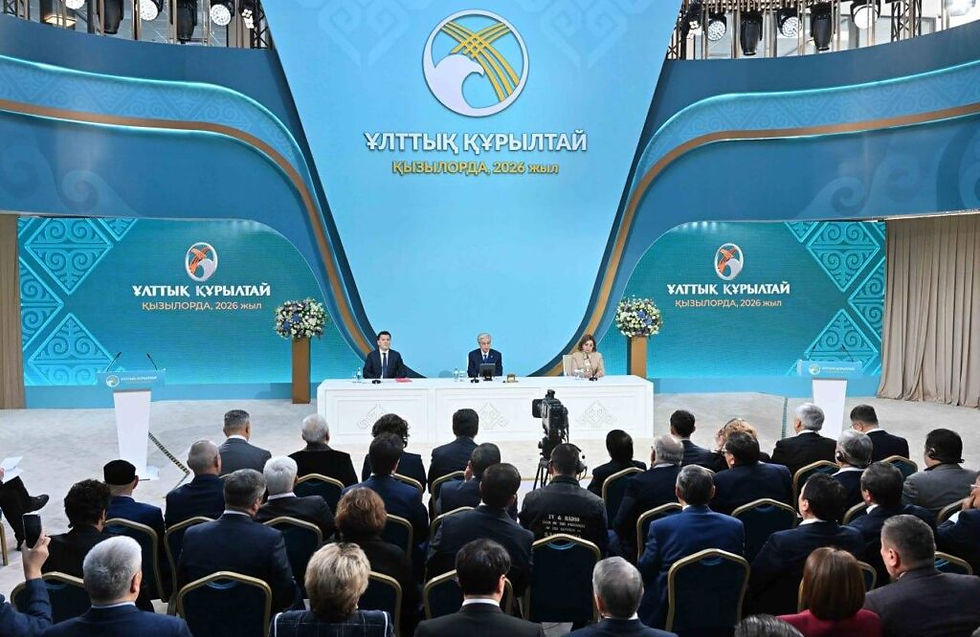
On January 20, 2026, Kazakh President Kassym-Jomart Tokayev proposed a series of constitutional reforms at the Fifth Kurultai (National Assembly) of Kazakhstan. These reforms included establishing a vice-presidential position, changing the bicameral parliament to a unicameral system, and restructuring the consultative mechanism. These reforms are considered the most far-reaching institutional restructuring since the 2022 constitutional reforms.
In his speech, Tokayev emphasized, "The establishment of this position will stabilize the national governance process and ultimately clarify the hierarchy of power." He also clearly stated that the presidency will remain the core and highest position in the national system, and that establishing a vice-presidential position does not mean weakening presidential power.
01 Overview of Reform Content: From Vice-Presidential to Parliamentary System Reform
Kazakhstan's political reform plan encompasses multiple levels, aiming to reshape the national governance system. According to the proposal, the vice-president will be appointed by the president and confirmed by a simple majority vote in parliament. The president will define the vice president's powers, including representing Kazakhstan in international forums and negotiations, representing the president's interests in parliament, and participating in domestic and international political, scientific, cultural, and educational activities.
Tokayev also proposed that the constitution explicitly stipulate that presidential elections must be held within two months should the head of state's term end prematurely. This contrasts sharply with the current constitution, which stipulates that if the president is unable to perform his duties, his powers will be transferred to the speaker of the senator (upper house) until the end of the previous term.
Parliamentary system reform is also a core component of this reform. Tokayev advocates changing Kazakhstan's current bicameral parliament (composed of the Senate and the lower house) to a unicameral system, believing this will simplify government operations and shorten decision-making processes. The new parliament will consist of approximately 145 members, led by three vice speakers, and will have no more than eight standing committees.
02 Historical Background and Reform Process: From a "Super-Presidential System" to a Balance of Power
Kazakhstan's political reforms are not sudden, but rather a continuation of a systemic reform process that began in 2022. In March 2022, Tokayev announced in his State of the Nation Address that Kazakhstan would undergo "comprehensive reforms," focusing on limiting presidential power, expanding the role of parliament, and transitioning from a "super-presidential system" to a "presidential republic with a strong parliament."
As part of the 2022 reforms, Tokayev planned to step down as chairman of the ruling party and proposed that the president suspend party membership during his term and prohibit relatives of the head of state from holding public office. Simultaneously, the role of parliament was enhanced, including expanding the powers of the lower house, establishing a constitutional court, reforming the electoral system, and lowering the threshold for forming political parties.
Later in 2022, the Kazakh parliament and the Constitutional Council approved changing the presidential term to a single, non-renewable seven-year term, replacing the previous two five-year terms. This change was passed in the constitutional referendum in June 2022, with a voter turnout of 68.06% and support from 77.18%.
On September 1, 2023, Tokayev, in his latest State of the Nation Address, reiterated the importance of amending the presidential term limits and proposed bringing forward the general election, originally scheduled for 2024, to November 2022. This decision was interpreted as Tokayev seeking a clear mandate from the people to accelerate the reform process.
03 Reform Strategy in a Geopolitical Context
Kazakhstan is located in the heart of Eurasia, holding a crucial geopolitical position. Tokayev, a "career diplomat" with 47 years of civil service experience, is fluent in multiple languages, has served as Under-Secretary-General of the United Nations, and is well-versed in both Eastern and Western political systems. His diplomatic background profoundly influences Kazakhstan's reform path and international positioning.
Tokayev emphasizes balance and diversity in his foreign policy. After being re-elected president in November 2022, he stated that Kazakhstan would continue to pursue a balanced multilateral foreign policy, prioritizing cooperation with Russia, China, and Central Asian countries.
Following his re-election, Tokayev first visited Russia, then France, a move reflecting his strategic thinking on balanced diplomacy.
Economic factors are also a crucial consideration in driving reforms. Kazakhstan's economy faces severe challenges, and Tokayev frankly stated that "the international situation is tense, and global development faces various uncertainties." Therefore, the government will formulate systematic anti-crisis measures to ensure the stability of the national currency, which is "a key factor in our country's economic security."
Simultaneously, Tokayev has prioritized digitalization and artificial intelligence development as national strategic priorities, aiming to promote economic diversification through technological innovation and reduce over-reliance on a natural resource-export-based economy.
04 Impact on Central Asia and the Global Landscape
Kazakhstan's political reforms have a profound impact on Central Asia. As the largest and most economically developed country in Central Asia, Kazakhstan's political direction is often seen as a regional bellwether.
Successful reforms in Kazakhstan may provide other Central Asian countries with a model for political transformation.
Kazakhstan is a founding member of the Eurasian Economic Union and an active member of the international community. Its political and economic trends not only affect the country itself but also the entire region and other countries in the world. Especially against the backdrop of the ongoing Russia-Ukraine conflict and the reshaping of the global geopolitical landscape, Kazakhstan's stability and reforms are attracting significant attention.
Analysis indicates that Tokayev's reforms aim to address domestic and international pressures and improve governance efficiency. By strengthening the role of representative institutions while reducing the complexity of the political structure, Tokayev is seeking to enhance the governance capacity of the Kazakh government.
Some experts believe that these reforms will increase the government's sense of responsibility to the people, reflected in the attitude of allowing the people to participate in government decision-making when addressing major strategic issues. "A strong president, an influential parliament, and a responsible government constitute Kazakhstan's new 'power formula'."
Russian political scientist Ivan Prekhorenko points out that due to the reforms, the parliament will become more autonomous, but this is mainly symbolic. He believes that Tokayev is readjusting power to suit his own needs and goals, one of which is his commitment to a power transition in 2029.
With the formation of the Constitutional Council, Kazakhstan's political reforms have entered the "final stage." The draft of the new constitution will be submitted to a national referendum, marking another major political decision following the 2022 referendum. Global observers are closely watching this process, as it not only concerns Kazakhstan's future but will also impact the geopolitical balance of the entire Central Asian region.
Tokayev once stated, "Every decision I make is based on considerations of national interests; we need to carefully adjust the country's political model." In today's volatile global landscape, this Kazakh leader's political reform experiment undoubtedly provides an important real-world case study for the political transition in developing countries.


Comments