


Three South Caucasus Leaders Meet in Antalya as Turkey Reshapes Regional Hub Influence
- Times Tengri
- Apr 27
- 3 min read

On the multilateral diplomatic stage of the 5th Antalya Diplomacy Forum (ADF 2026), Azerbaijani President Ilham Aliyev and Georgian Prime Minister Irakli Kobakhidze paid successive visits to Türkiye and held bilateral talks with Turkish President Recep Tayyip Erdoğan. The three countries reached a series of consensus on energy, transportation and security, marking an accelerated implementation phase of the South Caucasus regional cooperation framework led by Türkiye.
Coming shortly after the indirect US-Iran talks in Islamabad on 11–12 April, Türkiye used the forum to strengthen its geopolitical voice across the South Caucasus and the Middle East, forming a trilateral cooperation structure integrating energy, transportation and security to counterbalance traditional influence exerted by Russia and Iran in the region.
Aliyev’s Visit to Türkiye: Deepening Energy and Defence Cooperation
Azerbaijani President Ilham Aliyev arrived in Türkiye between 16 and 19 April. Aside from attending the forum, he held closed-door meetings with Erdoğan focusing on three core areas.
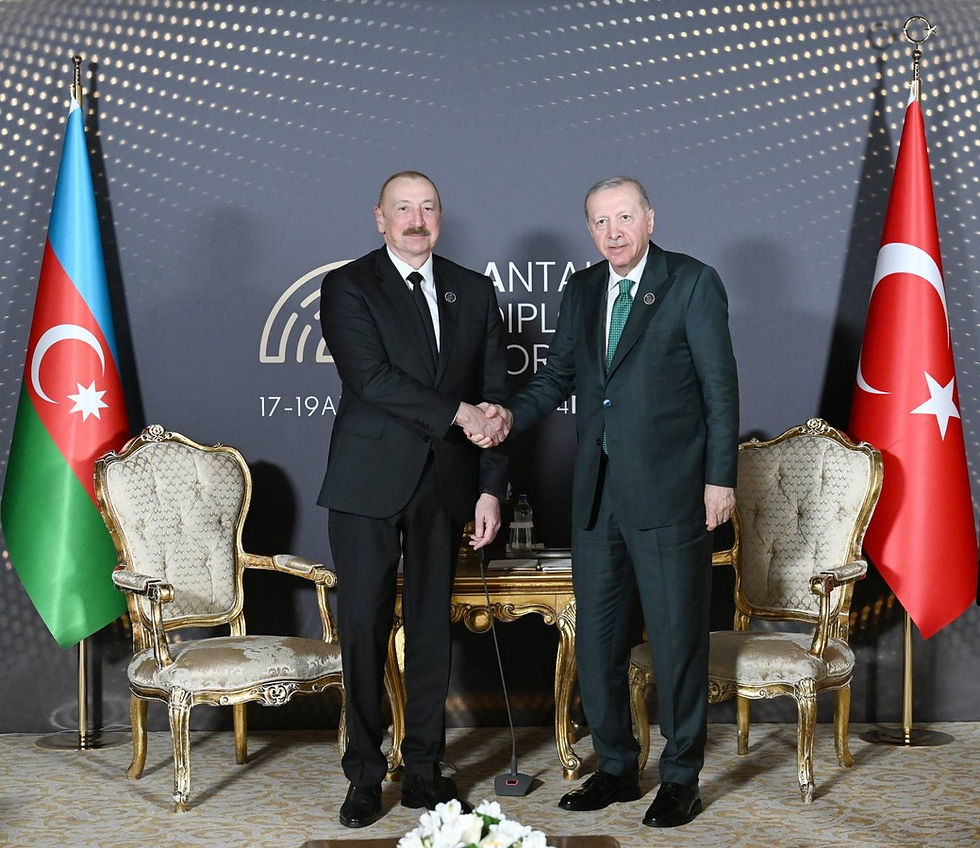
In energy, both sides confirmed the acceleration of two green energy corridor projects, covering the Azerbaijan–Türkiye–Europe and Azerbaijan–Georgia–Türkiye–Bulgaria routes. They also agreed to expand the capacity of the Trans-Anatolian Natural Gas Pipeline (TANAP) to enhance European energy supply security. Turkish Energy Minister Alparslan Bayraktar stated that bilateral energy cooperation was critical to regional and European energy security.
On transportation and defence, the two sides deepened joint military exercises under the Zulfiqar framework and upgraded the Trans-Caspian-Anatolian logistics network. Aliyev clearly identified Türkiye as a “strategic ally” and stressed the central role of connectivity linking the South Caucasus, Anatolia and the Mediterranean.
During the forum, Aliyev also held a trilateral meeting with Pakistani Prime Minister Shehbaz Sharif and Erdoğan to discuss regional security and economic integration, injecting new momentum into multilateral regional cooperation.
Kobakhidze’s Visit to Türkiye: Anchoring Georgia’s Eurasian Hub Status
Georgian Prime Minister Irakli Kobakhidze attended the forum from 17 to 19 April and held bilateral talks with Erdoğan on the same day, focusing on regional connectivity and security coordination.

Transportation cooperation stood at the heart of the discussions. Both sides pledged to speed up upgrades to railways and ports along the Middle Corridor, deepen integration between the Trans-Caspian transport network and Türkiye’s logistics system, and strengthen Georgia’s function as a Eurasian transport hub.
On energy coordination, the two leaders reaffirmed support for the stable operation of the Baku–Tbilisi–Ceyhan (BTC) oil pipeline and promoted cross-border renewable energy transmission in line with regional green transition goals.
Kobakhidze described Türkiye as Georgia’s “primary strategic partner” and noted that stability in the South Caucasus carried significant weight in the Eurasian order. He called for deeper trilateral cooperation on border security and counter-terrorism to jointly maintain regional stability.
Restructuring the Regional Landscape: Türkiye’s Dominance Strengthened
The intensive high-level interactions among the three countries reflect Türkiye’s growing influence in the South Caucasus. The fraternal ties between Azerbaijan and Türkiye extend from cultural affinity to strategic alignment, while Georgia uses the partnership to consolidate its role as a regional hub, forming a complementary and mutually beneficial cooperation bloc.
From a geopolitical perspective, Türkiye has used the Antalya Diplomacy Forum as a multilateral platform to combine Azerbaijan’s energy advantages and Georgia’s transport hub functions, while balancing external influence in the region. It is gradually building a regional cooperation system centred on itself. This arrangement not only raises the South Caucasus’ profile in global energy and supply chain security but also provides a new framework for regional stability in the post-Ukraine war era.
Amid rising global geopolitical uncertainty, Türkiye, as host, has advanced trilateral cooperation in line with its strategy as a regional power, while bringing new development opportunities to the South Caucasus. The pace of implementation of energy and transport projects between the three countries will serve as a key indicator of the effectiveness of regional cooperation, and will profoundly shape the geo-economic trajectory of the South Caucasus and the wider Eurasian continent.


Comments