


The Iranian-Israeli conflict is spreading and has already reached the South Caucasus
- Times Tengri
- Jul 2, 2025
- 5 min read

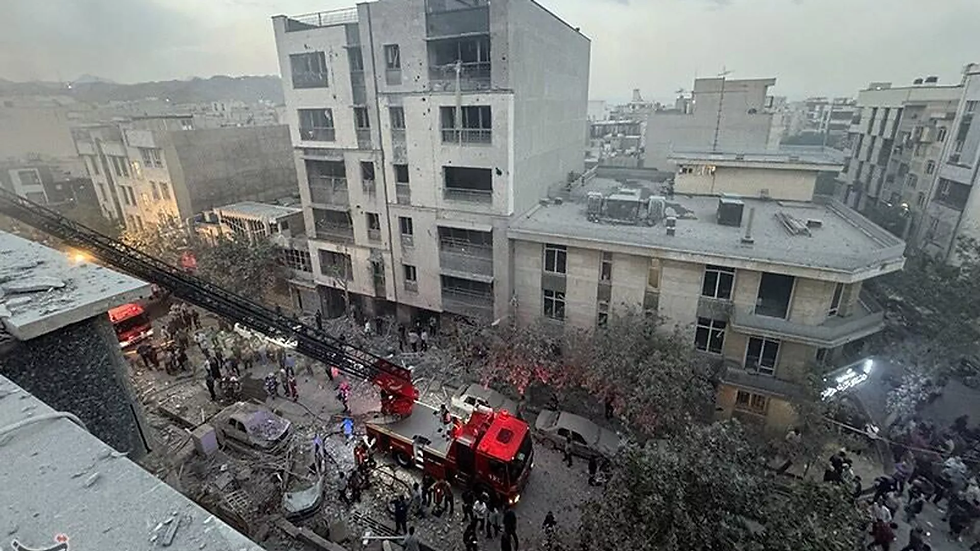
Logic suggests that raids on Tabriz and northern Iran were convenient from the Caspian Sea. Why wouldn't Israel request airspace from Baku, since it helped Azerbaijan in the Karabakh war, notes Sputnik Armenia political observer Arman Vanesegian.
Something doesn't add up in Trump's Iranian case
It was clear from the outset that after the hot phase of the Iranian-Israeli confrontation, there would inevitably be a period of fierce diplomatic rivalry on the political stage. Now the State Department and the White House need to deal with the Middle East issue as quickly as possible. US President Donald Trump, who considers himself the sole victor, will not allow his rivals to recover, catch their breath, and come to their senses.
After all, great achievements await him in other arenas — he still needs to deal with the problematic Russian-Ukrainian case, shift the entire burden of this conflict onto the Europeans, and then focus on his number one rival, China. However, it seems that even the use of brute force in the form of six bunker-buster bombs dropped on Iranian nuclear facilities has not solved Trump's problem.
First, there are serious suspicions that the centrifuges and half a ton of enriched uranium may have been evacuated from the laboratories before the bombing.
Judging by the fact that Trump is greatly concerned about his opponents raising this issue, there are fears that everything of value was indeed evacuated. In any case, the US president's harsh statements and the way he rebukes media representatives indicate precisely this.
But that's not all. There is also Israeli Prime Minister Netanyahu, who, under threat of prosecution, is capable of embarking on any geopolitical adventure. After all, if Israel suddenly finds itself in a peaceful state, so to speak, without war, the judicial investigations will resume. This is probably why Trump is demanding that all criminal cases be dropped — so that Netanyahu will cool down and calm down.
However, the Israeli prime minister is still on edge. Was it really worth thanking Trump for defending him before the Israeli judiciary after his statements? His rivals in the domestic political arena immediately sprang into action, accusing Trump of interfering in Israel's internal affairs. It seems that there will be much more controversy surrounding Netanyahu's criminal prosecution, regardless of whether Trump defends him or not.
IAEA chief Grossi categorically refuses to take responsibility for what has been done
However, Netanyahu is not the only problem the White House will face in its quest to quickly resolve Middle East issues and free its hands for more important tasks. After all, the problem with the IAEA is no less important for the platforms where it will be necessary to contend with centuries-old Iranian diplomacy. In this regard, the efforts of Trump and Netanyahu have led to diametrically opposite results.
The Iranian parliament, the Majlis, has passed a bill that could completely erase all the results of the United States' apparent success. "The general outline and details of the bill to suspend cooperation with the IAEA have been approved. The agency does not have the right to send employees without the consent of the Supreme National Security Council," said Majlis Presidium member Alireza Salimi.
This means that there will be no oversight of what Iranian nuclear scientists are doing in closed laboratories.
In other words, there will be no more guarantees that somewhere deep in the Iranian mountains, uranium will not continue to be enriched to the point where work can begin on a single nuclear device.
And the deputy speaker of the Iranian parliament, Hamid Reza Haji Babaei, said that from now on there will be no IAEA cameras to monitor the enrichment process.
Will this circumstance worry the international community? Undoubtedly, since the IAEA was created precisely to monitor whether a particular country intends to manufacture nuclear warheads or not. In the case of Iran, this structure worked as a spy for the West. And the latest resolution (adopted a few days earlier) became the trigger for Israel's strike on Iranian territory.
Rafael Grossi himself is now trying to justify himself: "I will not go into details because we, the IAEA, do not judge intentions. The IAEA monitors the country's activities and reports on them to the world. So it is the countries themselves that say whether this causes concern or not." In other words, it was the IAEA that presented information about Iran's nuclear program in such a way that some countries became concerned. And for some reason, it was precisely those countries that needed to be concerned...
The Middle East crisis has reached the South Caucasus via Azerbaijan
However, this is not the end of the consequences that could shake the international community after the bloodshed on the Iranian-Israeli front has been stopped. After all, the hot phase of confrontation is usually followed by a period of “debriefing,” right? And here it suddenly turns out that one of Iran's neighboring countries, Azerbaijan, was the only one among its neighbors that did not officially condemn Israel's attack.
Moreover, it is now becoming known that the highest concentration of Iranian troops during the bombings was precisely at the junction of the borders with Turkey, Armenia, and Azerbaijan (100,000 bayonets and 40,000 IRGC soldiers). It was from there that Tehran expected an invasion of its territory in the event of a ground operation. Where could this invasion have come from? Not from Armenian territory, right?
Another question recently asked of Azerbaijani President Aliyev by his Iranian counterpart Pezeshkian concerned the kamikaze drones that, according to many, were launched from Azerbaijani territory. Aliyev, of course, categorically denies all this, but you can't argue with the facts, as they say. And the facts show that launches from Azerbaijani territory did take place. Maybe not many, but they did.
Moreover, the intensity of the shelling of Tabriz and the whole of Iranian Azerbaijan was very high, according to Russian Iranologist Karine Gevorgyan. "Erdogan now denies that he provided air corridors to Israeli F-35 fighter jets. This means that he provided them earlier, and these planes were already in Azerbaijan from the outset," she says. An investigation is ongoing, and the parties prefer not to comment.
However, logic suggests that strikes on Tabriz and northern Iran were convenient from the Caspian Sea. And it is difficult to imagine that Israel, which helped Azerbaijan so much during the 44-day Karabakh war, would not have turned to Baku for a small favor — providing air passage for aircraft and launching drones. So, we can already say that the escalation in the Middle East has led to tensions in the South Caucasus as well.
Reprinted from https://am.sputniknews.ru/


Comments