


The CICA Think Tank Forum Opens in Baku: Exploring New Paths for Resonance between Security and Development in Asia

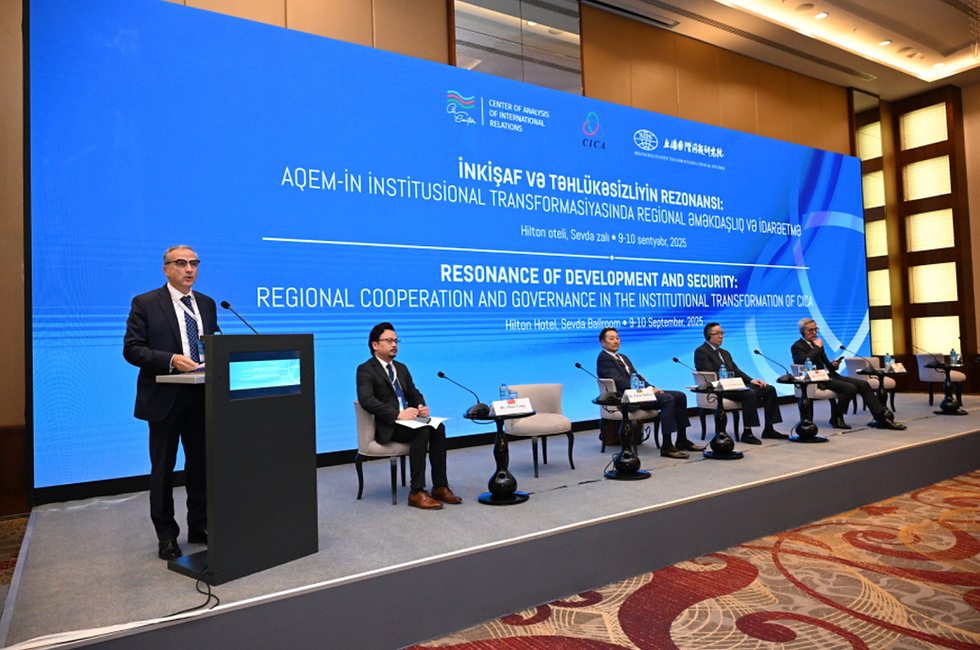
Scholars from think tanks from 16 countries gathered in the Azerbaijani capital to provide intellectual support for the transformation of the CICA mechanism and regional cooperative governance.
On September 9, 2025, the 13th Conference on Interaction and Confidence Building Measures in Asia (CICA) Think Tank Forum grandly opened in Baku, the capital of Azerbaijan. This was the first time the forum was held outside of China since its inception in 2014, marking a new phase in CICA think tank exchanges.
The forum, co-hosted by the Shanghai Institutes for International Studies and the Azerbaijan Center for Analysis of International Relations, was themed "Resonance between Development and Security: Regional Cooperation and Governance in the Transformation of the CICA Mechanism."
Nearly 50 think tank scholars from 16 countries gathered to discuss issues related to Asia's development and security in a multipolar world, providing intellectual support for promoting sustainable cooperation in the region.
01 Forum Background: A Critical Moment in the Transformation of the CICA Mechanism
The Conference on Interaction and Confidence Building Measures in Asia (CICA) was established in 1992 at the initiative of Kazakhstan at the 47th United Nations General Assembly. It is dedicated to developing and implementing multilateral confidence-building measures to enhance peace, security, and stability in Asia.
Today, CICA has 28 member states and 10 observer states, as well as five observer organizations and six partner organizations, making it the most extensive, largest, and most representative regional security forum in Asia.
In 2022, CICA proposed its transformation from a multilateral forum to an international organization. In July of this year, CICA's new headquarters building was completed in Astana, Kazakhstan, and the first Senior Officials' Committee meeting since its completion was held, marking a solid step forward in CICA's transformation.
02 Organizers and Participants: A Diverse Convergence of Intellectuals
This forum was co-hosted by the Shanghai Institutes for International Studies and the Azerbaijan Center for Analysis of International Relations. Azerbaijan President Ilham Aliyev sent a congratulatory letter to the forum, demonstrating the high regard his government attaches to it. At the forum's opening ceremony, Farid Shafiyev, Director of the Azerbaijan Center for Analysis of International Relations, Kairat Sarbai, Secretary-General of the Conference on Interaction and Confidence-Building Measures in Asia (CICA), Yan Wenbin, Ambassador to the Department of European and Asian Affairs of the Chinese Ministry of Foreign Affairs, and Chen Dongxiao, President of the Shanghai Institutes for International Studies, delivered speeches.
The speakers emphasized that in the face of global multipolarity and complex security challenges, CICA should deepen think tank dialogue, explore new paths for reconciling development and security, and contribute to regional stability and prosperity.
Ding Tao, Minister-Counselor of the Chinese Embassy in Azerbaijan, was invited to attend the forum. Ambassadors to Azerbaijan from Afghanistan, Iran, Iraq, Israel, Jordan, Kazakhstan, South Korea, Russia, Pakistan, and Uzbekistan attended the opening ceremony.
03 Agenda Setting: Responding to Core Issues of Regional Concern
The forum featured four thematic sub-forums covering key issues of security and development in Asia.
Experts at the forum discussed a new approach to security governance: promoting security through development. They also explored how to implement a common, comprehensive, cooperative, and sustainable Asian security vision, address non-traditional security challenges in the digital age, and proposed a uniquely Asian approach to security governance.
The forum analyzed the centrality of Asian supply chains and how to enhance resilience under the restructuring of globalization. They also explored how to integrate sustainable development concepts, address geopolitical risks, and leverage digital technologies to promote transformation.
Connectivity and infrastructure development were key topics at this forum. Scholars discussed how to better align and collaborate on a series of connectivity projects, including China's Belt and Road Initiative, Azerbaijan's Middle Corridor, and India's North-South Corridor.
04 Baku: Azerbaijan's Active Role
The choice of Baku as the venue for this forum holds special significance. Azerbaijan currently holds the rotating chair of the CICA (2024-2026), and this forum was initiated by Azerbaijan.
In February 2025, the CICA Senior Officials' Committee approved Azerbaijan's proposal to hold the annual Think Tank Forum in Baku.
Shi Jing, an assistant researcher at the Institute of International and Regional Studies at Tsinghua University, noted that in recent years, Azerbaijan and other Caucasian countries have been active in multilateral forums and have close relations with China. The forum's holding in Baku reflects "a mutual willingness on both sides to move toward the same goal."
05 CICA Think Tank Forum: From Creation to Institutionalization
The CICA Think Tank Forum mechanism was established in March 2014. On the eve of the CICA Shanghai Summit, the Shanghai Institutes for International Studies took the lead in establishing the mechanism to contribute ideas and suggestions for the development of CICA.
Over the following eight years, the CICA Think Tank Forum held eight consecutive roundtable meetings and produced numerous research reports and Chairman's Statements on the development of CICA, which had a wide impact within CICA member states.
Under the joint efforts of all parties and with the unanimous consent of CICA member states, the CICA Think Tank Forum officially became a permanent institution within the CICA mechanism starting in 2021.
As the inaugural chair, the Shanghai Institutes for International Studies continues to promote the forum as an important platform for gathering the wisdom of member states and fostering trust and cooperation.
06 China's Role: Active Participation and Contribution
As a founding member of the CICA, China has consistently actively participated in the CICA process. During the Fourth CICA Summit held in Shanghai in May 2014, China proposed practicing a common, comprehensive, cooperative, and sustainable Asian security vision, which received a positive response from all parties.
CICA Secretary-General Sarbai said, "China is one of CICA's most active members and has put forward many important initiatives for CICA's development."
During its CICA Chair from 2014 to 2018, China promoted the establishment of the CICA Non-Governmental Forum, the CICA Youth Council, and the CICA Business Council, deepening CICA's cooperation with multilateral mechanisms such as the United Nations and the Shanghai Cooperation Organization, significantly enhancing CICA's international influence.
Currently, China serves as the coordinator or UN coordinator for the implementation of confidence-building measures in seven areas, including finance and agriculture, and actively participates in cooperation under frameworks such as the CICA Youth Council and the CICA Business Council.
07 Considering Security Challenges and Development Needs
As the forum convenes, Asia faces numerous security challenges. Over the past year, the security situation in Eurasia has remained tense, including the protracted Israeli-Palestinian conflict and the unresolved Ukrainian crisis.
From May 6 to 10, 2025, a new round of conflict erupted between India and Pakistan; from June 13 to 25, the so-called "12-Day War" broke out between Iran and Israel, during which Iranian nuclear facilities were attacked by the United States and Israel.
Qiang Xiaoyun, Director of the Center for Russian and Central Asian Studies at the Shanghai Institutes for International Studies, pointed out: "This year's various security issues in Eurasia are not limited to the member states of the Conference on Interaction and Confidence-Building Measures in Asia (CICA). All international multilateral mechanisms across the Eurasian continent will face similar challenges."
This situation also highlights the uniqueness of CICA: "Across Asia, concerns about common security and common security threats have led to a greater willingness to discuss issues of mutual concern on multilateral platforms like CICA, hoping to identify new approaches."
08 Think Tank Network: A Bridge Connecting Policy and Academia
As a bridge connecting policy and academia, the CICA Think Tank Forum continues to provide intellectual impetus for Asia's security and development. As the CICA transitions from a forum to an international organization, this mechanism will play an even more important role in building a new Asian security architecture.
Qiang Xiaoyun stated, "With such a vast network of think tanks, we can access firsthand information and make informed assessments of current events. This not only helps us understand major and minor events occurring in Asia and across the Eurasian region, but also helps us disseminate Chinese policies to other think tanks in Asia in a timely manner."
Shi Jing stated that the overall security environment in Eurasia has remained unstable in recent years. In such circumstances, "having a forum where we can sit together and discuss peacekeeping or dispute resolution is extremely important."
"I believe it is crucial for experts, especially those with a deep understanding of the regional situation, to understand each other's intentions, engage in exchanges, and build trust in such forums. This will also lay the foundation for relevant countries to formulate policies or resume communication."
The consensus and recommendations reached at the forum will provide policy references for member governments, contributing Asian wisdom to building a balanced, effective, and sustainable regional security architecture.
Experts attending the forum unanimously agreed that this forum provided useful insights for the transformation and upgrading of the CICA mechanism and provided an important platform for Asian countries to build consensus and jointly address the dual challenges of development and security.
Scholars attending the forum called for continued strengthening of exchanges and cooperation among think tanks to provide think tank solutions for the institutional improvement and practical exploration of the CICA.


Comments