


Japan's GGP Aids Tajikistan's Healthcare

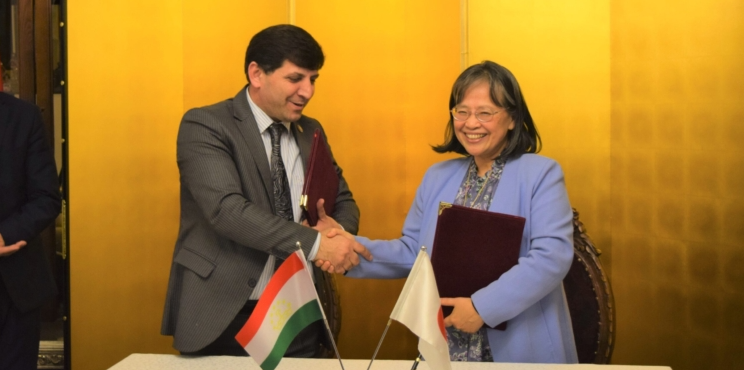
On January 27, 2026, Japanese Ambassador to Tajikistan Keiko Furuta and Khamisoda Khomichon, Director of the Dushanbe No. 14 Health Center, signed a grant agreement. Japan will provide US$352,530 for the upgrade and renovation of the center's medical equipment.
The project, named the "Dushanbe No. 14 Health Center Medical Equipment Upgrade and Renovation Project," will equip the center, located in the densely populated Xino district of the capital, with three of Japan's most advanced digital X-ray machines.
This aid is one of 470 humanitarian projects implemented in Tajikistan under Japan's "Grassroots and Human Security Assistance Program." Since 1996, Japan has provided US$39.2 million in aid to Tajikistan through the GGP.
01 Tokyo's Strategic Layout
The signing of this medical aid project is the latest manifestation of Japan's long-term strategy in Central Asia. In December 2025, Japan and the five Central Asian countries successfully held their first leaders' summit, signing the "Tokyo Declaration" and identifying healthcare as a priority area for cooperation.
At the summit, Japanese Prime Minister Sanae Takaichi announced an ambitious plan: to invest up to 3 trillion yen in business in Central Asia over the next five years. Cooperation focuses on three core areas: green resilience, connectivity, and talent development.
The “Central Asia + Japan” dialogue mechanism began in 2004, initially as a ministerial-level dialogue. The December 2025 summit elevated it to a head-of-state level meeting for the first time, marking a new stage in Japan-Central Asia relations.
Japan's medical assistance to Central Asia has a historical context. Research shows that the Japan International Cooperation Agency (JICA) has long been systematically providing health assistance to the five Central Asian countries; in Tajikistan, cooperation began in 1993.
02 Japan's GGP Aid Network and Specific Projects in Tajikistan
The Japanese government's “Government Grant Program for Grassroots Human Security” (GGP) is an important tool of its foreign aid. The GGP primarily provides assistance to local governments, educational and medical institutions, and international non-governmental organizations in developing countries.
In Tajikistan, the GGP has implemented 470 humanitarian projects since 1996, totaling US$39.2 million. These projects cover multiple areas, including healthcare, education, and water supply, directly benefiting local communities.
In June 2020, the Tajik Parliament approved a grant from the Japan International Cooperation Agency (JICA), with approximately US$8 million earmarked for equipment improvements at the National Medical Center and the Cardiovascular Surgery Center of Tajikistan.
In December 2025, during the "Central Asia + Japan" Summit, Tajik President Rahmon met with JICA Director General Akihiko Tanaka, and the two sides signed two new grant agreements covering upgrades to customs facilities and energy infrastructure, amounting to US$8.6 million and US$260,000 respectively.
03 The Geopolitical Landscape of Central Asia and Japan's Strategic Position
Since their independence in 1991, the five Central Asian countries have pursued a "multi-pronged diplomacy," seeking a balance among major powers. Kazakhstan advocates "Eurasianism," Uzbekistan has shifted towards "open neutrality," while Turkmenistan gained permanent neutrality recognized by the United Nations as early as 1995.
Japan's Central Asia policy has undergone a series of evolutions. From "Silk Road diplomacy" to the "Central Asia + Japan" dialogue, and then to the "Arc of Freedom and Prosperity," Japan has continuously explored ways to cooperate with Central Asian countries.
Academic research indicates that Japan's health aid to Central Asia aims to serve Japan's long-term national interests by improving medical and health services and strengthening public health management, and "cooperates with the United States' attempts to contain the influence of China and Russia in Central Asia."
The 2025 summit emphasizes cooperation focusing on green transformation, key mineral supply chains, energy security, and public health, reflecting the shared needs of both Japan and Central Asia.
04 Practical Benefits and Long-Term Impacts of Medical Aid
Japan's medical aid to Tajikistan has had a substantial impact. The digital X-ray machines provided will significantly improve the quality, accessibility, and speed of disease diagnosis, especially in infectious disease diagnosis, thereby improving the health status of the capital's residents and the healthcare system.
Similar medical aid projects have numerous precedents in Tajikistan and other Central Asian countries. In 2007, Japan implemented the "Primary Healthcare Service Improvement Program" in Tashkent and Jizzakh regions of Uzbekistan, providing disposable medical equipment to rural medical centers.
In Kazakhstan, Japan implemented the "Semibalaginsk Region Healthcare Improvement Project," establishing preliminary screening, precise diagnosis, and definitive diagnosis systems in highly polluted areas, effectively improving the regional healthcare system.
These aid projects not only improved local healthcare standards but also enhanced the sustainability of healthcare systems through personnel training and technology transfer. Japanese experts were dispatched to Central Asian countries, and local medical personnel received training, disseminating medical technology and knowledge.
05 International Aid and the Development Path of Central Asia
International aid has always played a crucial role in global politics. Through medical aid to countries like Tajikistan, Japan has not only improved local healthcare conditions but also enhanced its own soft power and influence in international affairs.
Central Asian countries have demonstrated a high degree of pragmatism when accepting foreign aid. They are adept at utilizing multilateral diplomacy, seeking a balance among major powers to maximize their own interests. As the analysis points out, "the five Central Asian countries understand that geopolitical value does not equate to being exploited."
Japan's aid strategy in Central Asia emphasizes "high-quality infrastructure" and "human security guarantees," which aligns with Japan's advocacy in global health governance.
As competition among major powers intensifies in Central Asia, international aid has become an important diplomatic tool. However, Central Asian countries consistently prioritize their national interests when accepting aid, carefully maintaining a balance among all parties.
With the commissioning of three Japanese digital X-ray machines at the Dushanbe Health Center No. 14, Tajikistan's medical diagnostic capabilities will be enhanced.


Comments